
Business Requirements Gathering & ERP Selection
Project Timelines: August 2014 – March 2015
Client Characteristics: A Discrete Manufacturer in the packaging (food grade boxes for the premier fast-food delivery and pizzerias, aluminum cans – for all the cola brands and corrugated boxes for large scale cargo packaging) line of business,
Annual Revenues in FY 14 – AU$ 5 Billion
Target the transformation to Industry 4.0 in a span of 5 years
Evaluating the need for replacement of their disparate business systems (ERP, MES, Logistics and Raw Material procurement) – SAP R/4 4.6 being the version targeted for replacement
Developing the To-Be business processes for enabling Shop-Floor to Top-Floor connectivity for real time decision support
Rationalize the Application Footprint of over 100 different applications acquired as a process of expansion and acquisition
Develop the transition plan towards adoption of the new ERP and the related application modernization
Industry Sector: Packaging Industry
Business Problem: The client was one of the largest players in the packaging industry in Australia with a history of over 30 years and addressing some of the most marquee clients in the Food and Beverage Industry globally.
The organisation had, as a part of its growth, expanded upstream (raw material development and procurement) and set up a global supply chain across the Asia Pacific. A lot of this growth had also been inorganic leading to mounting technical debt and high cost of IT Operations. As reflected below, the expectations from the business transformation included,
- IT Perspective
- Zero IT (everything “as a Service”)
- Consumption based (Scalable and Elastic)
- Simple, Standard, Impactful & Efficient
- Business Unit Perspective
- Increase Competitiveness, Customer Focus & Agility
- Best Practices
- Cost Reduction, Efficiency & Effectiveness
- Compliance Adherence
- Corporate Perspective
- Transparency & Data Consistency
- Integrated Supply Chain
- Reduce Operations Risk through modernisation and standardisation
- Core Division
- Consolidate/Standardise >50 Business Systems
- Modernise LGX & VIPA (two of the legacy applications)
- Automate/Standardise Manual processing
- Consolidate CRM (Customer Relationship Management)
- Introduce WMS (Warehouse Management) and Network Optimisation
- International trading
- Consolidate, Standardise, Streamline Systems & processes
- Transport Management
- Modernise technology to gain world class operations
- Mobility
- Modernise technology to unlock workforce & customer value
- Org. Data Transparency/Consistency
- Unified cross referenceable view across Procurement, Customers & Employees
Our Approach to Solving the Business Problem:
Leveraging our proven approach for technology selection, the following steps were adopted:
Step #1: Process GAP Assessment – Understanding the areas for improvement from the current business processes and modelling the future state business requirements. The APQC’s Process Classification Framework for Discrete Manufacturing with best practices drawn from various industry benchmark studies was leveraged to create the reference business process model. This model was used as the reference, in conjunction with the Business Analysis Core Concept Model™ (BACCM™), drawn from BABOK and a detailed requirement analysis was done.
Deliverables: (a) To-Be Business Process Model; (b) Areas for Improvement in comparison to the current state business processes
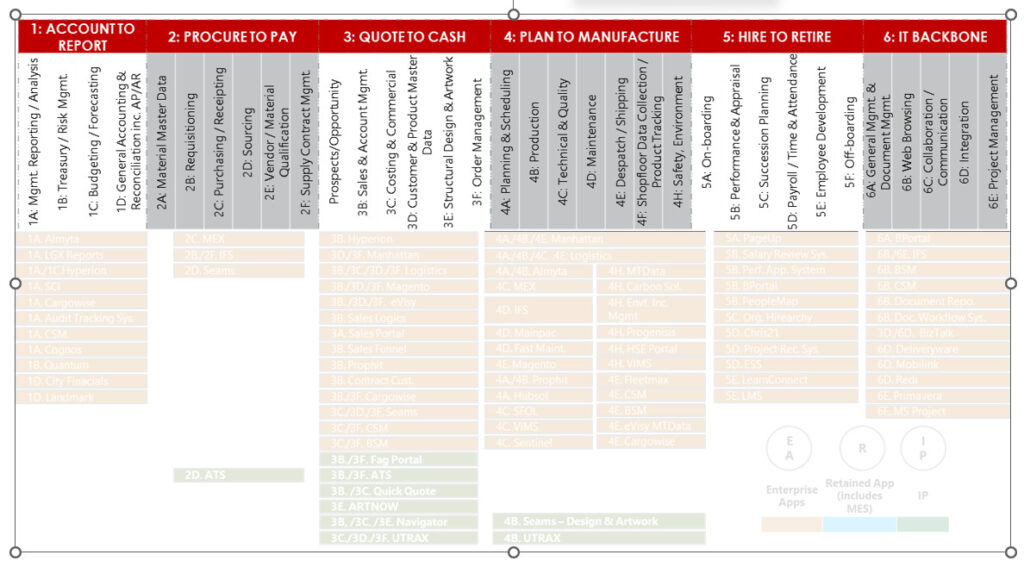
Step #2: Application Rationalization Assessment – Comparing the current technology coverage with an intent to, (a) Identify Coverage Index – the extent of current technology and its capability to address the future business process model; (b) Risk Impact Analysis – Using the Failure Mode Effect Analysis (FMEA) approach, identified risks that may impact the transformation journey (factors include, architectural dependence; application dependence; data dependence; infrastructure dependence; operational dependence and environmental risks); (c) IT Efficiency – addressing the parameters of complexity and application stability attributing to technical debt; and (d) IT Business Value – covering the Agility and its weighted risk index drawn from the Risk Impact Analysis.
Deliverables: (a) Application Rationalization Matrix with the application portfolio distributed into the 4 categories of (i) Replace / Retire; (ii) Re-engineer; (iii) Re-evaluate; and, (d) Retain; (b) Application areas of Improvement that need to be addressed through re-engineering or re-evaluation of a new ERP / Functionality.
The rationalized application portfolio for the client as presented with categorization for (a) Enterprise Applications (as the basis for the new ERP Requirements); (b) Retained Applications (including the MES and those that cannot be replaced; and, (c) a series of Intellectual Properties created that differentiated the organization’s competitively.
Step #3: Application Selection Criterion & Business Case definition – Leveraged our predefined Evaluation Approach for identification of a new ERP or enhancement of the existing ERP. In addition, this step includes the creation of a Business Case for supporting / negating the change. The figure below reflects the Evaluation Criterion for the ERP Selection.
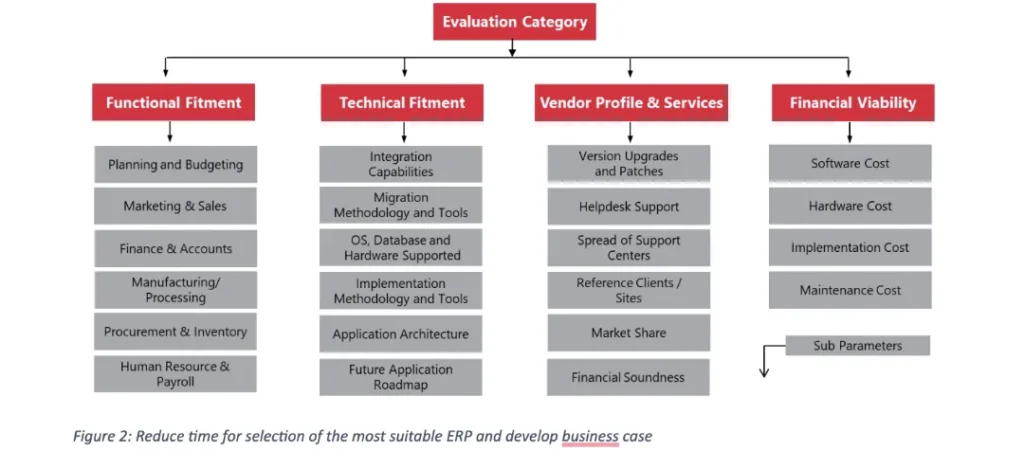
Deliverables: (a) ERP Evaluation Criterion; (b) ERP Requirements for Functional Fitment; and, RFP Generation
Step #4: ERP Evaluation and Total Cost of Ownership definition – Based on the response to the RFP; Product Demonstration and Integration feasibility, the ERPs were objectively ranked under the following heads:
- Functional Fitment Score
- Vendor Profile Score
- Mandatory Requitements Coverage
- Department wise user Feedback Score
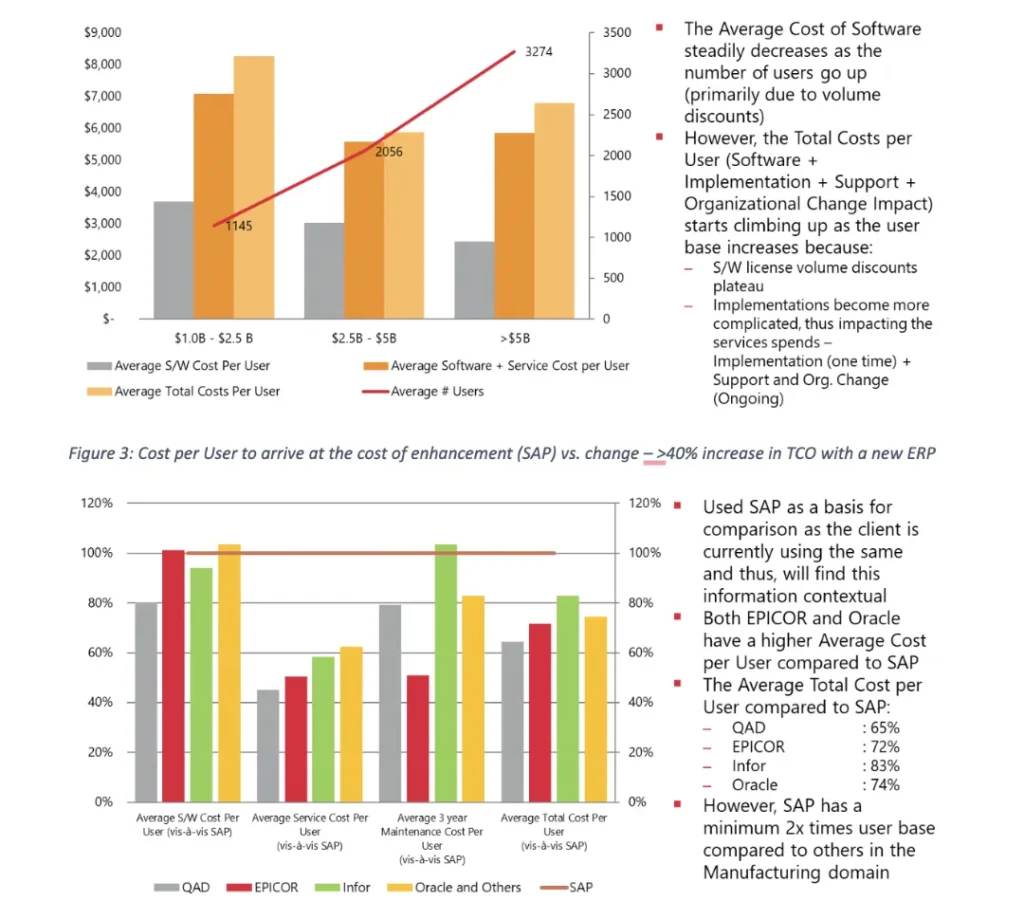
Deliverables: (a) ERP Evaluation and Ranking; (b) ERP Business Case and TCO definition
Outcome delivered
The client was recommended to go ahead with enhancement of their SAP R/4 4.6 to SAP / HANA. The approach led to:
- Reduction in the application footprint from 107 to 32
- Breakeven period of less than 4 years for this transformation
- Complete transparency and proactive line planning with shop floor to top floor integration
- Single, cloud based procurement planning and logistics application for advanced planning and optimization
About Us – Vivikta Advisory
Vivikta Advisory: Enterprise Architecture Excellence
Vivikta Advisory embodies the Sanskrit essence of “purity, discernment, and distinguished wisdom” – core attributes of transformative Enterprise Architecture practice. With over 30 years of proven leadership in strategic and tactical organizational transformation, Vivikta delivers business-outcome-focused methodologies across global enterprises.
Proven Global Impact
- Portfolio Scale: Led $500M+ transformation programs across 50+ countries, 5 continents
- Cross-Disciplinary Expertise: Business Architecture, framework definition, requirements engineering, process reengineering, and digital transformation advisory
- Niche Focus: Enterprise Architecture lifecycle governance – Strategy, Capabilities, Governance (excluding solution development/implementation)
AI-Era Architecture Leadership
Vivikta specializes in Business Architecture-led digital transformation, anchoring enterprise-wide:
- Capability Mapping & Roadmapping: Aligning business imperatives with architectural foundations
- AI/GenAI Readiness: Governance frameworks for responsible AI, MLOps, data architectures
- Regulatory Compliance: NIST-aligned risk management, data sovereignty, ethical AI guardrails
- Decision Frameworks: Build/Buy, Replace/Reengineer, portfolio rationalization
Methodology Excellence
Anchored in TOGAF, Zachman, Gartner, FEAF best practices, Vivikta’s “Define → Change → Check → Measure → Improve” lifecycle delivers:
- 20-35% data governance cost reductions through metadata/entity frameworks [from prior analysis]
- Sustainability-first, persona-centric process/application designs
- ArchOps operationalization for continuous architecture evolution
Vivikta Advisory: Pure EA lifecycle guidance for the intelligent enterprise – where business strategy meets resilient governance in the AI-driven era.
Leveraging these capabilities, we can be our client’s partner of choice for their transformation consulting initiatives.
Disclaimers
All representative models, delivered architectures, frameworks and artifacts are ownerships of the
represented client. Vivikta Advisory & Creatives has no intellectual property rights on these deliverables. All information provided is to our best knowledge as on date of creating this case representation. Any changes led by business or environmental changes are outside the purview of Vivikta Advisory & Creatives.
© 2026 Vivikta Advisory. All rights reserved. The views, opinions, and analyses expressed in this content represent those of Vivikta Advisory and its employees only.
No part of this content may be quoted, reproduced, distributed, or used in any form without prior written permission from Vivikta Advisory.
This material is created for informational purposes and does not intentionally reference, resemble, or imply any specific persons, organizations, or proprietary information. Vivikta Advisory disclaims any liability arising from reliance on this content.