
Prelude
This is an Enterprise Architect’s perspective on the approach to scale the NextGen Solutions (read, AI/Generative AI/LLMs/Deep Learning led business solutions). A part of the 3 Point-of-View Thought Leadership series, this article focuses on the two foundational aspects – Leadership Archetypes its impact and learnings from two distinct Waves of Technology led Business Transformations. Thus, establishing a framework for enabling success in achieving the expected business outcomes.
The Shifting Dilemma – CxO’s Archetypes
Stemming from an interesting range of discussions with C-Suites over the last few weeks, made me to start thinking of the set of CxO Archetypes[1] and their approach towards balancing innovation and risks. A corollary was the extent of impact these archetypes have on the adoption and scale decisions for AI/Generative AI / Deep Learning programs (a.k.a. NextGen) in their organisations.
On one end of the spectrum was the exploration of plausible business scenarios for leveraging NextGen technologies. This was during a strategic tête-à-tête with a CxO from a known Low-Cost Carrier in Middle East with its services to the Indian Sub-Continent and Europe. The focus was on breakthrough improvement to impact its Competitive Index for Customer Growth & Retention and becoming the Preferred airlines for Millenia and Gen Z. Major ‘Red Flags’ that emerged, can be grouped into, (a) Cost of training the models and their accuracy / RoI vs. traditional models; (b) Protocol used for accessing these services (read ‘secure, monitored and effectively logged’); (c) Delivered through “users’ channels of choice” and, (iv) Risk of loss of critical business information to competitors / aggregators.
On the other end of the spectrum was the discussion of architecting a Decision Support engine with generative capabilities for “Multiple What-if Scenarios based on multi-variate independent variables for predicting an outcome of a competitive sport or the dependent variable.” Major points of discussions included, (a) Sources of data needed to train the models for >95% accuracy with “hallucinations” tending towards Zero; (b) Decision Parameters with weights for enabling What-if scenarios with variable confidence intervals; (c) Access to finetune these parameters (e.g. impact of athlete injury or weather), through a “human-in-loop” setup; and (d) Continuous “supervised learning” to improve the model and provide the “user persona ” with personalised “Recommended Actions” to improve performance.
The point to note is that both the CxOs were convinced about Nextgen approaches, a significant shift from less than a decade ago (circa 2016). Their concerns were predominantly related to costs, organisational / project risk appetite and the commensurate business value (outcomes). In comparison, these discussions in 2016-2018 were focused on convincing the CxOs on the viability of these NextGen approaches. Thus, the good news is the absence of a “Not considering” category.
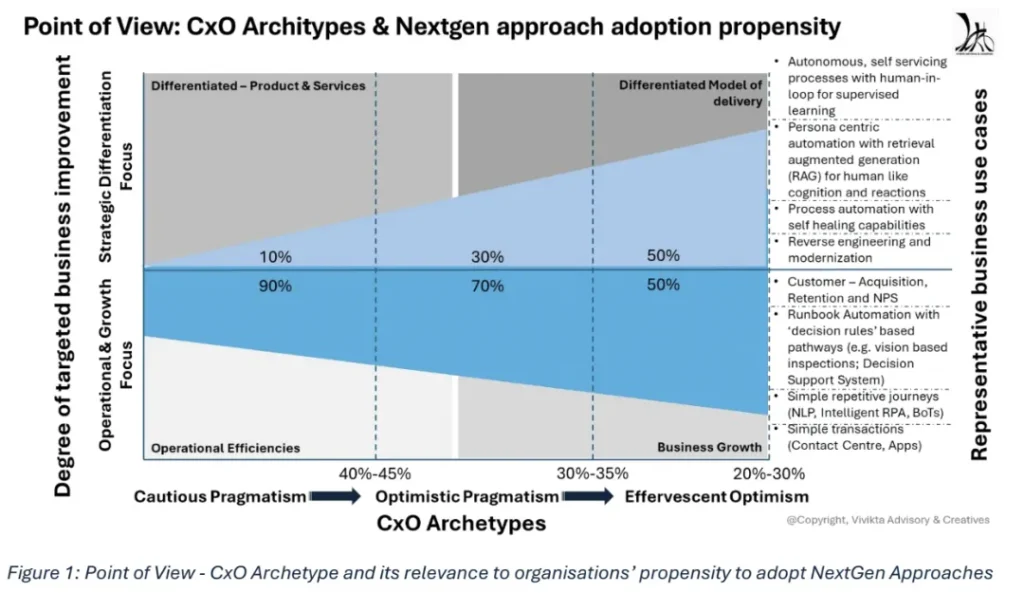
With this backdrop, the derived CxO Archetypes can be grouped by their “pragmatic risk-taking appetite” and the way they approach their organisation’s expected business goals. These goals, leveraging the NextGen approaches can represented on a quadrant, with focus on, (a) Operational Efficiencies; (b) Business Growth; (c) Differentiated products and services; and (d) Differentiated model of delivering these products and services. The CxO Archetypes aligned to their response to these goals and based on their unique combination of behaviour traits include,
- Cautious Pragmatist
- Optimistic Pragmatist
- Effervescent Optimist
Circling back to the two discussions cited above, and many others that I have, as an Advisor and Enterprise Architect, these CxO Archetypes have a direct impact on their propensity to invest in NextGen approaches. The figure below, summarises my point of view on the CxO Archetypes and its impact adoption of NextGen approaches.
Is it déjà vu or what – The Nextgen Wave
With over 30 years in the Industry, working closely with the CxO fraternity, are we seeing the third wave of constructive disruption, which aims to bring to reality numerous works of fiction we saw as a part of the Generation X? The flip phones, mobility, interactive virtual reality / augmented reality, teleportation (with video, telepresence now becoming mainstream), remote robotic surgeries and Smart network of edge devices!
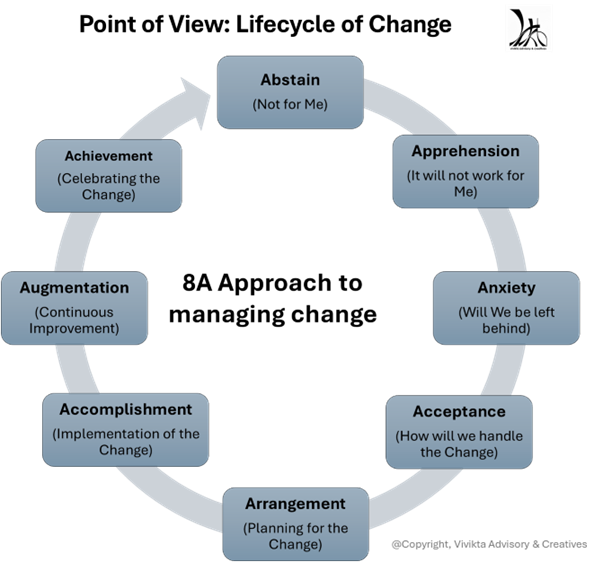
It is indeed true, and so is the fact that with every wave we go through the same lifecycle of change. Figure 2 above outlines these changing “viewpoints” and remains true even for the NextGen Approaches.
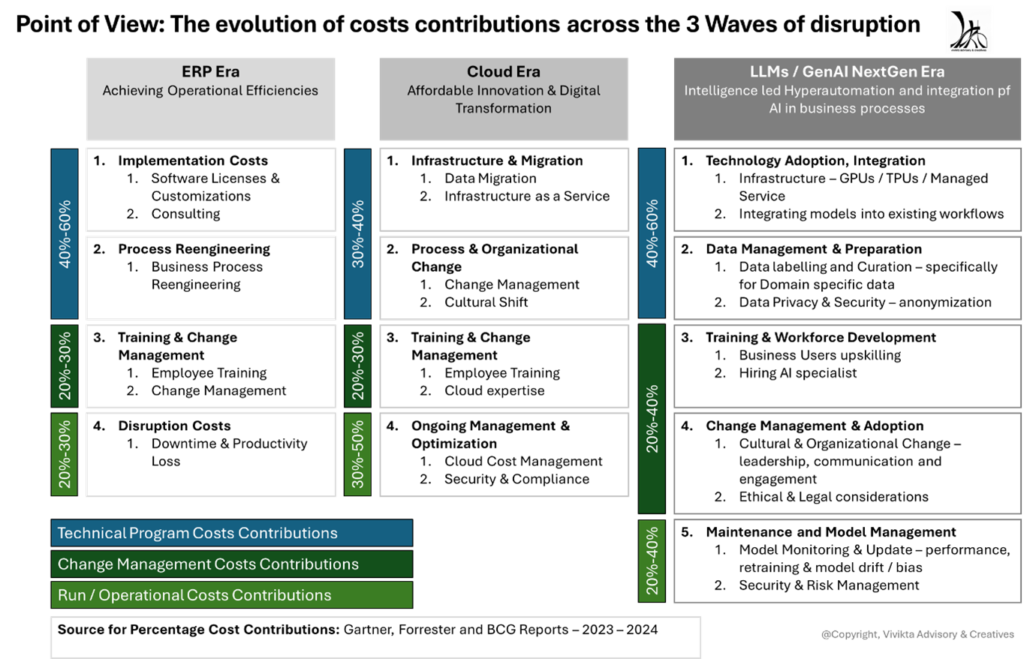
Thus, as an industry what we are going through with NextGen approaches appears to me as déjà vu (see Figure 3). As Enterprise Architects, we aim to rise above the specificities to a layer of “meaningful abstraction” to visualise apparent patterns. Don’t we see the similarities in approaches, apprehensions, risks and adoptions to the ERP Era (circa, 1980 – 2000s) and the Cloud Adoption Era (late 2000s to now) as we now go through the LLMs / GenAI based NextGen Era (early 2020s onwards) approaches? And so is the case with the CxO Archetypes and their influences on the adoption for such changes! So, shall we conclude that the NextGen too, seems daunting now, but poised for delivering the expected business value, as the other two Waves?
The Nextgen Wave – Poised to leverage the Foundational Capabilities
An interesting perspective is the natural state of evolution that makes our businesses more ready that ever for adoption of NextGen Approaches. Some scenarios below may explain the evolution of these foundational capabilities and the exponential growth in supporting ecosystem for providing the proverbial “escape velocity” for the NextGen approaches,
- Pre ERP Era was personified with lots of manual paper-based work and limited disparate system silos. Would a “common pane of business management” be possible for effective and timely decision support across an organisation? Will this organisation be able to move from a “Local to a Global” perspective thus, enabling optimisation and reuse?
- ERP Era was personified with establishing a common business process with underlying system of records and “well defined entity relationships.” While a common pane of business management was possible, it was limited by geographical and organisational units’ (such as Supply Chain vendors, Customers etc…). Limited Interoperability primarily because of lack of a common “global” entity definition (classes, types, members and attributes etc…) a common global regulatory framework, besides the cost of computing made RoI from such investments challenging.
- Cloud Era was personified by moving an on-premises workload to the Cloud using Virtual Machines (VMs). While this made the ERPs and Business Applications Available, the Confidentiality, Integrity (of the CIA Triad) and costs came under scrutiny. With the evolution to XaaS containerised workloads and “Pay-as-you-Use” pricing, the ERPs and business applications required a major rehaul. The need for secure, interoperable data movement / interchange required the ecosystem to establish protocols and regulatory frameworks to govern the same.
- LLMs / GenAI based NextGen Era as we face today is placed on this incremental evolution (see Figure 4) with decreasing cost of computing, numerous time-tested models with ever optimising design for delivery (with underlying ML / Deep Learning accesses as service). With large volumes of structured data and unstructured data, a mature meta data framework (either in the form of organisational transaction and knowledge systems or as data generated by the ecosystem of edge devices, social and informational sources). Would this era be possible without the underlying evolution of ERPs, Data Lakes, Mobility, Social Media, Cloud Computing, Edge Devices and the ever-expanding ubiquitous networking layer enabling information democratisation?
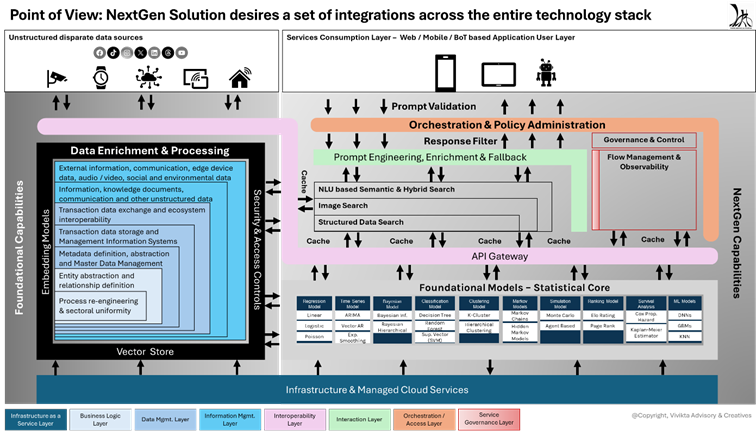
Figure 4: The NextGen Wave, leveraging the Foundational Capabilities with a set of integrations across the entire technology stack!
In conclusion, the NextGen Wave is here to stay. We will continue to evolve by developing the needed Policy Frameworks, Implementation Guidelines, Measurement Approaches and Change Governance to drive the inherent benefits from of this approach. We will also continue to address the strategic, ethical and information risks, as the promised benefits far outweigh the cost for managing these risks.
Till then, keep these simple and fundamentals takeaways as checkpoints while you evaluate use cases or plan to scale those in the pipeline,
- Focus on measurable outcomes – Bottomline Improvement (EBIDT); Profitable Growth Impact (Cost per Customer acquisition / retention); and technical feasibility to scale within the established “controls.”
- Move above “point solutions” towards integrated solutions that can scale.
- Plan for Change – NextGen solutions are designed for business users to work with directly, thus plan for 1.5 – 3X factor for adoption and operations.
- Establish an organisational governance framework – to avoid plethora of individual preferences for choice of LLMs / Technologies / Tools / Hosting approaches.
- Rise above classifying NextGen approaches as technical solutions – Appreciate that technology is just the enablers, it is the business users’ problems that we are trying to solve.
- Adopt an abstracted approach to solution development – focus on reuse across functions / departments / use case models.
This article is the first in a series of three Point-of-Views on NextGen approaches. The next will outline the emerging Governance Framework, thus making enterprise wide / global adoption possible. That will be followed by a recommended RoI framework that provides an unbiased view for choosing the most appropriate initiatives and approaches to get the desired outcomes.
——- End of Article ——
About the Author
Vivek Mahendra, Managing Partner, Vivikta Advisory, has over 3 decades of global professional experience, is an Inclusive Healthcare Evangelist, Author, Enterprise Transformation Advisor, Certified Corporate Director (Institute of Directors), Digital Product Visionary and TOGAF Certified Enterprise Architect. He has over 9 publications, 12 Intellectual Property assets, and 1 Patent in technology led NextGen business solutions.
[1] Merriam Webster defines archetype as ‘the original pattern or model of which all things of the same type are representations or copies.
About Us – Vivikta Advisory
Vivikta Advisory: Enterprise Architecture Excellence
Vivikta Advisory embodies the Sanskrit essence of “purity, discernment, and distinguished wisdom” – core attributes of transformative Enterprise Architecture practice. With over 30 years of proven leadership in strategic and tactical organizational transformation, Vivikta delivers business-outcome-focused methodologies across global enterprises.
Proven Global Impact
- Portfolio Scale: Led $500M+ transformation programs across 50+ countries, 5 continents
- Cross-Disciplinary Expertise: Business Architecture, framework definition, requirements engineering, process reengineering, and digital transformation advisory
- Niche Focus: Enterprise Architecture lifecycle governance – Strategy, Capabilities, Governance (excluding solution development/implementation)
AI-Era Architecture Leadership
Vivikta specializes in Business Architecture-led digital transformation, anchoring enterprise-wide:
- Capability Mapping & Roadmapping: Aligning business imperatives with architectural foundations
- AI/GenAI Readiness: Governance frameworks for responsible AI, MLOps, data architectures
- Regulatory Compliance: NIST-aligned risk management, data sovereignty, ethical AI guardrails
- Decision Frameworks: Build/Buy, Replace/Reengineer, portfolio rationalization
Methodology Excellence
Anchored in TOGAF, Zachman, Gartner, FEAF best practices, Vivikta’s “Define → Change → Check → Measure → Improve” lifecycle delivers:
- 20-35% data governance cost reductions through metadata/entity frameworks [from prior analysis]
- Sustainability-first, persona-centric process/application designs
- ArchOps operationalization for continuous architecture evolution
Vivikta Advisory: Pure EA lifecycle guidance for the intelligent enterprise – where business strategy meets resilient governance in the AI-driven era.
Leveraging these capabilities, we can be our client’s partner of choice for their transformation consulting initiatives.
Disclaimers
All representative models, delivered architectures, frameworks and artifacts are ownerships of the
represented client. Vivikta Advisory & Creatives has no intellectual property rights on these deliverables. All information provided is to our best knowledge as on date of creating this case representation. Any changes led by business or environmental changes are outside the purview of Vivikta Advisory & Creatives.
© 2026 Vivikta Advisory. All rights reserved. The views, opinions, and analyses expressed in this content represent those of Vivikta Advisory and its employees only.
No part of this content may be quoted, reproduced, distributed, or used in any form without prior written permission from Vivikta Advisory.
This material is created for informational purposes and does not intentionally reference, resemble, or imply any specific persons, organizations, or proprietary information. Vivikta Advisory disclaims any liability arising from reliance on this content.