
The GenAI Customization Trap – Custom Fit vs. Platform
The Hypothesis
Enterprise Architects are always in the pursuit of envisioning the future state of businesses, their ecosystem and its adoption of technology, ideally ahead of the curve. It’s not because we have a crystal ball that foretells the future. Instead, we work at the level of the foundational entities, whose transformative patterns and their variant, help predict the next possible pattern – using mathematical models.
Isn’t this what forms the foundations of the popular “Transformer Models” that are the secret behind the emerging GenAI wave? Or more profound, the genomic sequence for any living thing and the Periodic Table we studied as foundational chemistry.
In this paper, we aim to use a heuristics-based approach to prove the hypothesis for the NextGen Platform Debt Curve – advising my clients to move away from Custom AI / GenAI solutions to an Enterprise Platform based approach. This is based on the Enterprise Architecture foundations of; (a) Capability based planning; (b) Reference Architecture convergence; (c) Enterprise Ontologies; (d) Segregation of Controls vs. Execution; and (e) Interoperability Standards (MCP, Protocol First Integrations).
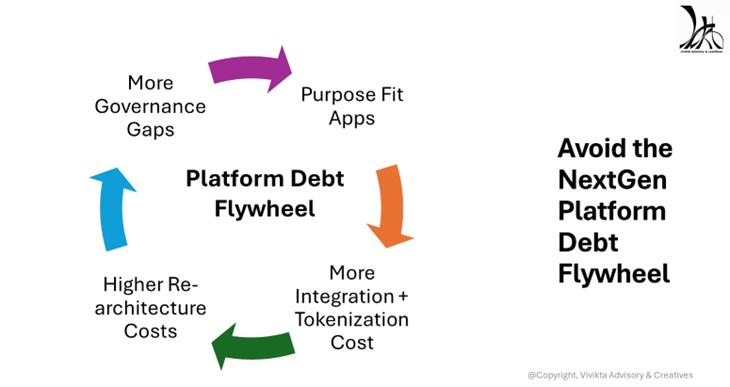
Across industries, NextGen adoption is accelerating without a shared enterprise fabric. This results in four systemic failure modes: (1) duplicated agents, (2) non‑portable prompts, (3) exponential integration overhead, and (4) runaway token costs.
The Genesis
This thought paper is an outcome of over 10 diverse client pursuits in the last 1 year. A year that has stands out with its sheer pace of adoption (and the rate of failures) of GenAI / AI / Hyperautomation / Intelligence led solutions. A year that moved away from the PoC Graveyards of the past two towards logical, enterprise scale adoption – predominantly for the support functions, if not the core.
These 10 clients represented the Fortune 500 – Payers, Pharmaceutical (generics and biosimilars) and Aviation sectors. While all of them are no longer living in the dichotomy of adopting NextGen solutions, nearly 100% are expecting “Out-of-the-Box” fitment for their specific functional areas – Revenue Cycle Management (RCM), Finance Reporting & Accounting (FRA) or Dynamic Pricing Engine (for Aviation Revenue Managers).
The Heuristics Framework
Referencing this era as Gartner states – The Intelligence Technology Supercycle, with it being in the first “quinquennium” (first 5 years) of a typical 20-year cycle, the year 2026 is expected to be the Trough of Disillusionment. Or in simple Terms – businesses will be unable to “prove the ROI – both capabilities led and commercially viable” from the NextGen solutions.
It’s important to trace this back to the previous two cycles post the Enterprise Data Processing Era (up to the late 1970s). Some heuristics that reflect a pattern we see with the Intelligence Technology Supercycle are provided below and are referenced for proving the Hypothesis.
A. Technical Debt from Pre-ERP Custom Application Era – bespoke, function specific systems (1970s – 1990)
- Customization: 70–90% of business logic was hard-coded
- Integration Costs: 30–50% of total IT spend went into point-to-point integrations
- Change Lead Times: 6–18 months for cross-functional change
- Upgrade Cost: Often equivalent to a full rewrite
- Knowledge Risk: High (tribal knowledge, single-vendor or single-team dependency)

B. ERP Evolution: From Customization → Configuration → SaaS (1990s – Present)
- Phase 1: Early ERP (1990s–early 2000s) – “ERPs must adapt to us”
- Custom Code: Up to 70%
- Implementation Time: 18-36 months
- Cost Overrun: 50%-200% +
- Upgrade Pain: Custom code broke updates
- Business Alignment: locally optimized, globally inefficient
- Phase 2: Best-Practice ERP (mid-2000s–2015) – “We adapt to ERP best practices”
- Custom Code: between 10%-30%
- Implementation Time: less than 6-12 months
- Change Impact: Isolated to “configuration”
- Upgrade Frequency: Regular, Predictable
- Governance: Integral to the process
- Phase 3: SaaS ERP (2015 – present) – “Consume Capability, not software”
- Custom Code: <10%
- Implementation Time: less than 16 weeks
- Change Management: Incremental, Continuous
- Cost Model: Subscription
- Innovation Velocity – Accelerated
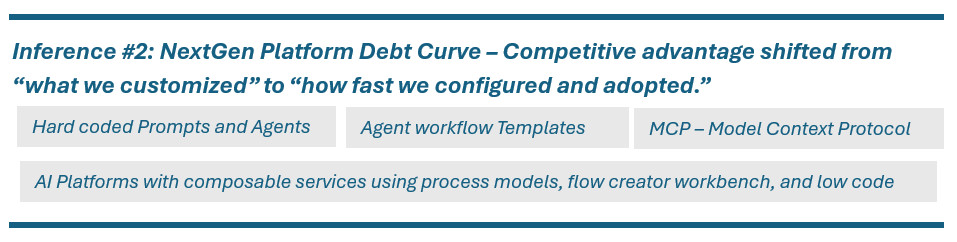
C. Cloud Evolution: VM Lift-and-Shift → Containers → Serverless (2010 – present)
- Phase 1: Lift-and-Shift (2010–2014) – VMs to Cloud, Same architecture, new hosting
- Cost Savings: marginal (5%-15%)
- Operating Model: Same as on-prem
- Elasticity (a key selling point): under-utilized
- Billing: Instance based (virtual bare metal)
- Phase 2: Cloud-Native Containers (2014–2019) – Shared Infrastructure, better density
- Resource Utilization: +30%-50%
- Deployment Time: Days à Hours
- Infrastructure Coupling: Loosely, yet not agnostic
- Cost Model: Per Cluster / Node
- Phase 3: Serverless / Managed Services (2019–present) – Event driven, Pay-per-Execution
- Biling Unit: Requests, duration, ingress/egress
- Idle Cost: Near zero
- Time to Market: Weeks à Days
- Operations Management: Minimal
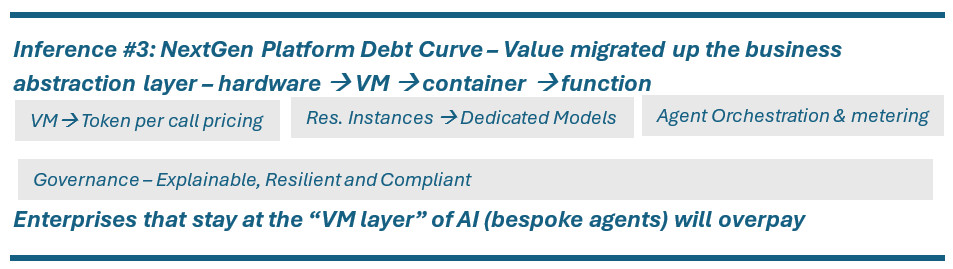
Thus, the inference we draw based on these heuristic patterns is obvious. These 10, globally most progressive organizations want to first optimize for functional fit, then later optimize for systemic efficiency.
However, they run the risk unlike anything seen earlier where a typical Failure Mode Effect Analysis (FMEA) led Risk Priority Number (RPN – Severity, Likelihood of Occurrence and detectability) on Purpose Built NextGen adoption will have multiplicative effects due to,
- Costs of Training and Retraining the models and the lack of a singular ontology based on the various businesses as a common reference master data
- Exponential integration complexity with the numerous underling application without a common integration (connectors) layer
- Astronomical costs related to tokenization with a lack of an “enterprise grade” well thought out token optimization strategy
- Integration nightmare across various purpose build applications
- Lak of a common governance framework across point solutions leading to security and compliance related risks without an overarching observability, explainability and audit services layer
The Outlook for 2026 and beyond
As architects, our objective is to lead our clients to effectively navigate this NextGen Platform Debt Curve by not repeating the same mistakes and achieve planned value goal faster, with minimal risks and least cost. Based on the inferences from the Heuristic Framework we have identified 6 key organizational Archetypes and their natural propensity towards Platform Centric vs. Purpose Fit adoption. These archetypes and their characteristics include,
A. Platform Pioneers (early adopters of platform-first)
Who: Regulated + scale-heavy organizations (banks, insurers, healthcare, aviation ops, public sector)
Why: High cost of failure → prioritize auditability, IAM, monitoring, policy gates
Pattern: Central “AI platform team” + domain product teams consuming via templates and connectors
Proof hooks: Risk-loss evidence + POC abandonment + scaling practices[i][ii]
B. Federated Platform Builders (strong EA + Business Unit autonomy)
Who: Multi-Business Unit conglomerates, global enterprises with strong product organizations
Why: They’ll build a core platform, but allow Business Unit “assembly lines” for agents/workflows
Pattern: “Golden path” platform + governance-as-code + app teams compose via UI tools
C. Toolchain Consolidators (followers—rationalize after experimentation)
Who: Enterprises that ran many pilots in parallel (often with vendor sprawl)
Trigger: Costs + inconsistent controls + security/legal pressure
D. Point-Solution Sprinters (purpose-fit first; platform later)
Who: Mid-market or product companies chasing quick wins + Global Capability Centres (GCCs) with limited autonomy and with a focus on local differentiation for the managed business processes (with limited fungibility across global operations)
Risk: Fragile integrations, inconsistent guardrails; “demo debt” becomes “production debt”
Path to platform: They adopt MCP/connectors to standardize integration as they mature.
E. Compliance-Blocked Experimenters (laggards by constraint, not intent)
Who: Organization with strict policies but weak enabling platform/architecture
Symptom: “AI is banned” or “only vendor X allowed,” stagnation due to missing control plane
Unlock: Build minimum viable control plane (IAM + audit + evaluation + approved connectors)
F. Shadow-AI Fragmenters (laggards by fragmentation)
Who: Decentralized organizations with high business pressure + low central governance
Symptom: Untracked usage, data leakage risk, duplicated effort
Fix: Standard platform + enterprise connector catalogue + usage telemetry
Thus, to reiterate the hypothesis, enterprises will increasingly adopt NextGen / GenAI via capability-rich, governed platforms (observability, explainability, auditability, IAM/SSO, cost controls, evaluation gates, safe connectors), while still enabling purpose-built solutions through UI-led composition (drag-drop workflows, prompt/agent builders) and protocol-led interoperability (MCP servers/connectors).

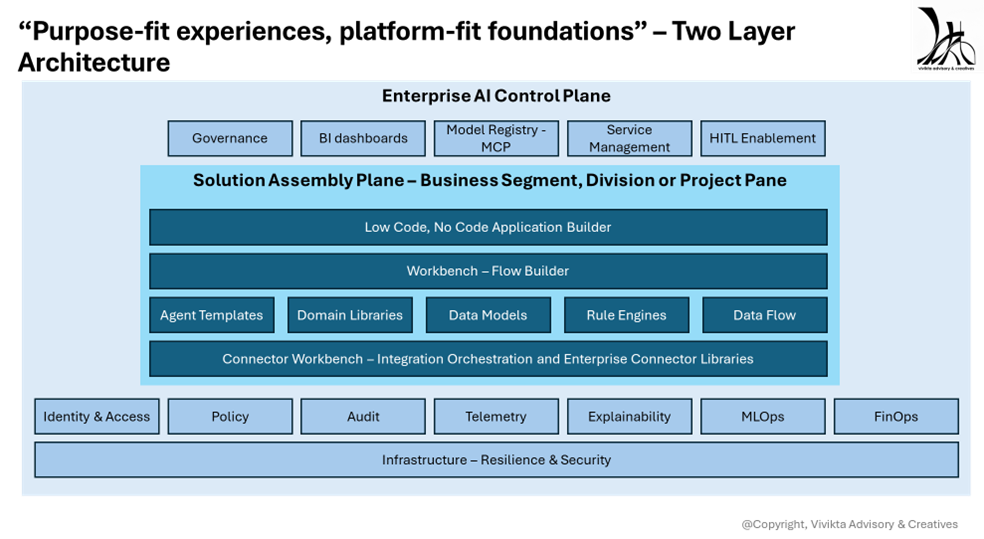
Enterprise Architect’s Playbook – Staying ahead of the curve not by building more Agents, but by building the fewest platforms that everyone can safely reuse
With the 6 archetypes defined, it is imperative that as Enterprise Architects, we lead these organisations to avoid the NexGen Platform Debt Curve. The Matrix below is a series of actions that takes them to the Plateau of Productivity (Ref: Gartner Hype Cycle) so that they go on the next Innovation Trigger, without going through the Trough of Disillusionment.
| Archetype | Primary Risk if Status Quo Continues | Target Operating Model (TOM) | Immediate 90-Day Actions | Platform Capabilities to Establish First | Outcome in 12–18 Months |
| Platform Pioneers | Platform becomes bottleneck or over-engineered | Federated Platform + Product Teams | Formalize AI Platform TeamDefine platform vs product decision rightsMandate onboarding to control planeMandate shared model and prompt registries | AI Control Plane (IAM, audit, cost)Common services catalogueProtocol-based integrations | Scalable, compliant AI at enterprise velocity |
| Federated Platform Builders | Fragmentation due to excessive autonomy | Golden-Path Platform Model | Publish “golden path” standardsIncentivize adoption vs mandateLaunch reusable templatesMandate shared model and prompt registries | Shared integration fabricDomain templates & connectorsPolicy-as-code | Innovation speed with bounded risk |
| Toolchain Consolidators | Permanent “GenAI legacy” and spiralling cost | Rationalize → Consolidate → Platformize | Inventory all AI tools & agentsFreeze net-new point solutionsCentralize logging & cost telemetry | Central orchestration layerToken / usage FinOpsShared prompt & model registry | Reduced cost, predictable scale, cleaner architecture |
| Point-Solution Sprinters | Painful re-architecture during scale | Platform-Lite, Platform-Ready | Externalize prompts & logicStandardize auth, logging, cost trackingAvoid bespoke connectorsStandardize on protocol‑based integrations (MCP, unified connectors) | Lightweight control planeProtocol-first integrationLow-code workflow builder | Faster growth without architectural reset |
| Compliance-Blocked Experimenters | Innovation freeze and shadow AI | Enablement-First Governance | Stand up safe AI sandboxApprove limited model setAutomate guardrails | Minimal viable control planeData redaction & auditExplainability hooks | Safe experimentation with visible governance |
| Shadow-AI Fragmenters | Unmanaged risk, duplication, data leakage | Visibility-First, Control-Later | Instrument usage & costsPublish shared connectorsOffer business-friendly builders | Usage telemetryShared learning repositoryGradual policy enforcement | Controlled adoption without cultural backlash |
In addition, address these common principles irrespective of the archetypes,
- Establish a Common AI Control Plane early – Audit, identity, cost, observability, policy enforcement
- Standardize integration before standardizing use cases – Protocol-led, “connect once, reuse many”
- Establish an enterprise-wide ontology framework – domain led, compliance driven and with ease of search
- Separate composition from execution – Business users assemble workflows; platform enforces guardrails
- Centralize learning, not ownership – Shared prompts, embeddings, evaluations, metadata
- Measure success by reuse and cycle time—not number of pilots
As Enterprise Architects, our mandate is no longer to simply guide technology adoption, but to ensure that innovation scales without debt.
Purpose‑fit GenAI experiences will continue to accelerate, but only those grounded in platform‑led foundations—shared control planes, enterprise ontologies, reusable connectors, and governed composition frameworks—will survive the next cycle of maturity. The organizations that thrive will be those that shift from building more agents to building fewer, more powerful platforms. By embracing a platform‑first strategy today, enterprises can deliver differentiated experiences with clarity, confidence, and long‑term architectural resilience.
[i] Most companies suffer some risk-related financial loss deploying AI, EY survey shows | Reuters
[ii] Gartner Predicts 30% of Generative AI Projects Will Be Abandoned After Proof of Concept by End of 2025
——- End of Article ——
About the Author
Vivek Mahendra, Managing Partner, Vivikta Advisory, has over 3 decades of global professional experience, is an Inclusive Healthcare Evangelist, Author, Enterprise Transformation Advisor, Certified Corporate Director (Institute of Directors), Digital Product Visionary and TOGAF Certified Enterprise Architect. He has over 9 publications, 12 Intellectual Property assets, and 1 Patent in technology led NextGen business solutions.
[1] Merriam Webster defines archetype as ‘the original pattern or model of which all things of the same type are representations or copies.
About Us – Vivikta Advisory
Vivikta Advisory: Enterprise Architecture Excellence
Vivikta Advisory embodies the Sanskrit essence of “purity, discernment, and distinguished wisdom” – core attributes of transformative Enterprise Architecture practice. With over 30 years of proven leadership in strategic and tactical organizational transformation, Vivikta delivers business-outcome-focused methodologies across global enterprises.
Proven Global Impact
- Portfolio Scale: Led $500M+ transformation programs across 50+ countries, 5 continents
- Cross-Disciplinary Expertise: Business Architecture, framework definition, requirements engineering, process reengineering, and digital transformation advisory
- Niche Focus: Enterprise Architecture lifecycle governance – Strategy, Capabilities, Governance (excluding solution development/implementation)
AI-Era Architecture Leadership
Vivikta specializes in Business Architecture-led digital transformation, anchoring enterprise-wide:
- Capability Mapping & Roadmapping: Aligning business imperatives with architectural foundations
- AI/GenAI Readiness: Governance frameworks for responsible AI, MLOps, data architectures
- Regulatory Compliance: NIST-aligned risk management, data sovereignty, ethical AI guardrails
- Decision Frameworks: Build/Buy, Replace/Reengineer, portfolio rationalization
Methodology Excellence
Anchored in TOGAF, Zachman, Gartner, FEAF best practices, Vivikta’s “Define → Change → Check → Measure → Improve” lifecycle delivers:
- 20-35% data governance cost reductions through metadata/entity frameworks [from prior analysis]
- Sustainability-first, persona-centric process/application designs
- ArchOps operationalization for continuous architecture evolution
Vivikta Advisory: Pure EA lifecycle guidance for the intelligent enterprise – where business strategy meets resilient governance in the AI-driven era.
Leveraging these capabilities, we can be our client’s partner of choice for their transformation consulting initiatives.
Disclaimers
All representative models, delivered architectures, frameworks and artifacts are ownerships of the
represented client. Vivikta Advisory & Creatives has no intellectual property rights on these deliverables. All information provided is to our best knowledge as on date of creating this case representation. Any changes led by business or environmental changes are outside the purview of Vivikta Advisory & Creatives.
© 2026 Vivikta Advisory. All rights reserved. The views, opinions, and analyses expressed in this content represent those of Vivikta Advisory and its employees only.
No part of this content may be quoted, reproduced, distributed, or used in any form without prior written permission from Vivikta Advisory.
This material is created for informational purposes and does not intentionally reference, resemble, or imply any specific persons, organizations, or proprietary information. Vivikta Advisory disclaims any liability arising from reliance on this content.